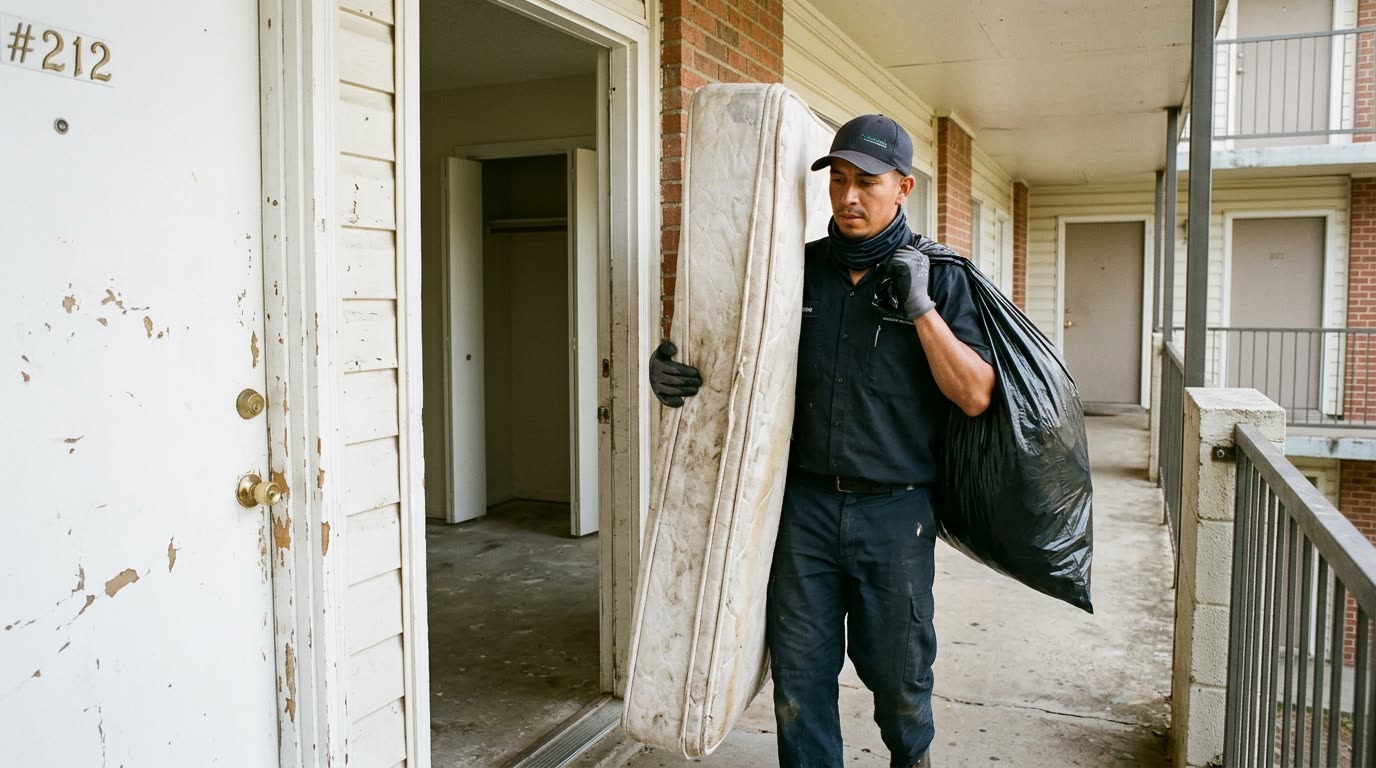
Turn units without losing days.
When a unit comes back trashed or an eviction hits, every day empty costs you. A&M clears it fast and clean — fully documented before and after — so you can make-ready and re-lease without the holdup.
Why managers rely on us
- Full clear-out, down to empty
- Documented for disputes & billing
- Bundles with turnkey turns & code-enforcement clean-ups
The invoice is the cheap part. The days aren't.
A trash-out is the gate every other turn task waits behind. Paint, flooring, punch, final clean — none of it starts until the unit is empty. Which means the vendor who clears it isn't setting your cost, they're setting your calendar.
Every vacant day is uncollected rent
Run your own number: daily rent times the days a unit sits waiting on a hauler. Compare that to the difference between a vendor who comes in 48 hours and one who books you for next week. On most units the delay costs more than the clear-out does — and unlike the invoice, nobody ever sees that line item.
The whole make-ready queue slips behind it
Your painter, flooring crew and cleaners are scheduled against a date that assumed an empty unit. Miss the clear-out and you're not losing one day, you're re-booking three trades and taking whatever slots they have left. One late haul cascades through the entire turn.
Turn time is what ownership actually watches
Nobody at the asset level is reviewing what you paid to empty a unit. They're reviewing days-to-lease and vacancy loss. A clear-out vendor who protects turn time is defending the number you get measured on — which is why speed is worth paying for and slowness never shows up as a saving.
In, out, documented.
Document in
We photograph the unit as found — your record before anything moves.
Clear out
Everything hauled — furniture, trash, appliances, debris — down to empty.
Document out
After photos delivered so you can bill the file and re-lease with confidence.
Every version of "the unit came back bad."
Some crews quote a trash-out, walk in, and suddenly the job "isn't what was described." We scope for the worst case up front so the number holds when the door opens.
Standard move-out
The furniture, mattresses and half-packed boxes nobody came back for. Straightforward volume work, and the fastest category to turn around.
Evictions and writs
Time-sensitive by definition and often scheduled against someone else's calendar. We work to the date you're given, document the unit as found before anything moves, and clear it in one visit.
Abandonment
Resident gone, unit still full, no forwarding address. Photographed thoroughly on the way in, because these are the files most likely to be questioned later.
Hoarding and heavy accumulation
The jobs other haulers quote once, see, and re-quote. We scope these honestly and bring the crew size the unit actually needs rather than discovering it on the day.
Estate and post-passing clear-outs
Handled with the discretion the situation calls for, at the pace the family and the property both need.
Code enforcement and post-incident debris
Deadline-driven clear-outs where the property is answering to somebody else. We move at that timeline and document to it.
Photos before anything moves.
The moment a unit is emptied, the only remaining record of what was in it is whatever someone photographed. If a former resident later disputes what was removed, or ownership questions a deposit deduction, that record is the entire argument.
So we shoot the unit as found — every room, condition and contents — before a single item is touched. Then again once it's down to empty. Both sets come to you with the job, timestamped, ready to attach to the file.
Most haulers treat documentation as a favor they'll do if you ask. On a disputed unit it's the difference between a deduction that holds and one you quietly write off. It's standard on every trash-out we run, at no additional cost.
What lands in your file
- As-found photos, room by room — before anything is moved
- Down-to-empty photos — proof of the condition handed back
- An itemized scope you can bill against without translation
- Certificate of insurance on request for your compliance file
How trash-outs are priced.
Volume is the headline, but it's rarely what separates two bids on the same unit. These are the inputs that actually move the number.
Volume
Priced by how much of the truck the unit fills. A studio stripped to the walls and a three-bedroom left fully furnished are different jobs, and the estimate reflects fill rather than floor plan.
Access
Third floor with no elevator costs more than a ground-floor unit at the curb, because it is more labor for the same volume. Carry distance to the truck matters as much as the stairs do.
Disposal class
Appliances, mattresses, tires, paint and electronics carry their own fees at the transfer station and can't legally go in a general load. These are itemized rather than buried, so you can see exactly what you're paying for.
Condition
Heavy accumulation, pest presence or biohazard changes crew size, protective equipment and time on site. We identify this on the walkthrough, not after the crew is standing in the doorway.
Speed
Same-day and after-hours mobilization carries a premium, because it means moving a crew off something else. Given what a vacant day costs, it is usually still the cheaper decision.
Standing volume
Communities that send us turns regularly are priced on route rather than one at a time. Predictable volume earns predictable pricing and a place at the front of the schedule.
A unit we've seen gets a number that holds. That's the whole reason we walk it first — the re-quote at the door is the single most expensive thing a clear-out vendor can do to your turn schedule.
Anyone can haul it. Very few protect the turn.
They haul it away. We hand you the file.
Before and after photos, an itemized scope, and a COI if your compliance packet needs one — delivered with the job. You close the work order the same day instead of chasing a vendor for evidence a week later.
They book you next week. We work in 24 to 48 hours.
On deadline work, availability is the service. A cheaper bid that clears the unit five days later isn't cheaper — it just moves the cost from your invoice to your vacancy report.
They re-quote at the door. We scope it before we come.
Hoarding, heavy accumulation and pest presence are the jobs most crews price optimistically and then renegotiate standing in the unit. We look first and give you a number that survives the front door.
They're one more vendor to chase. We keep going.
Clear-out, deep clean, pressure washing, minor repairs and haul-off under one insured crew. Hand us the keys after the writ and take them back rent-ready, without coordinating four companies against one date.
What managers ask us about trash-outs.
Most trash-outs are scheduled within 24 to 48 hours, and we mobilize sooner for genuine emergencies. If you're working to a writ date or an inspection, tell us the date on the first call and we'll build the schedule backwards from it.
We take them. Heavy accumulation, pest presence and units that have sat a long time need bigger crews, protective equipment and more time, so we want to see the unit before quoting rather than guess. What we won't do is give you an optimistic number and renegotiate it at the door.
Yes. These carry their own disposal fees and can't go into a general load, so they appear as their own line rather than being absorbed into a vague total. You'll see what each category cost.
As-found photos room by room before anything is moved, down-to-empty photos when we're finished, and an itemized scope you can bill against directly. Standard on every job, not an add-on — it's the part that protects you if the unit is ever disputed.
Yes — that's our turnkey service. Clear-out, deep clean, pressure washing where the unit needs it, minor repairs and haul-off, delivered rent-ready and documented. One crew, one contact, one invoice, and no gaps between trades where days go missing.
That's most of what we do. Communities sending us regular turns get route pricing, priority scheduling and a single point of contact who already knows the property, the access and the standard you hold. Portfolios can run under one agreement with consolidated billing.
Trash-outs across metro Atlanta
Got a unit to turn?
Call now for same-week scheduling — emergencies sooner.