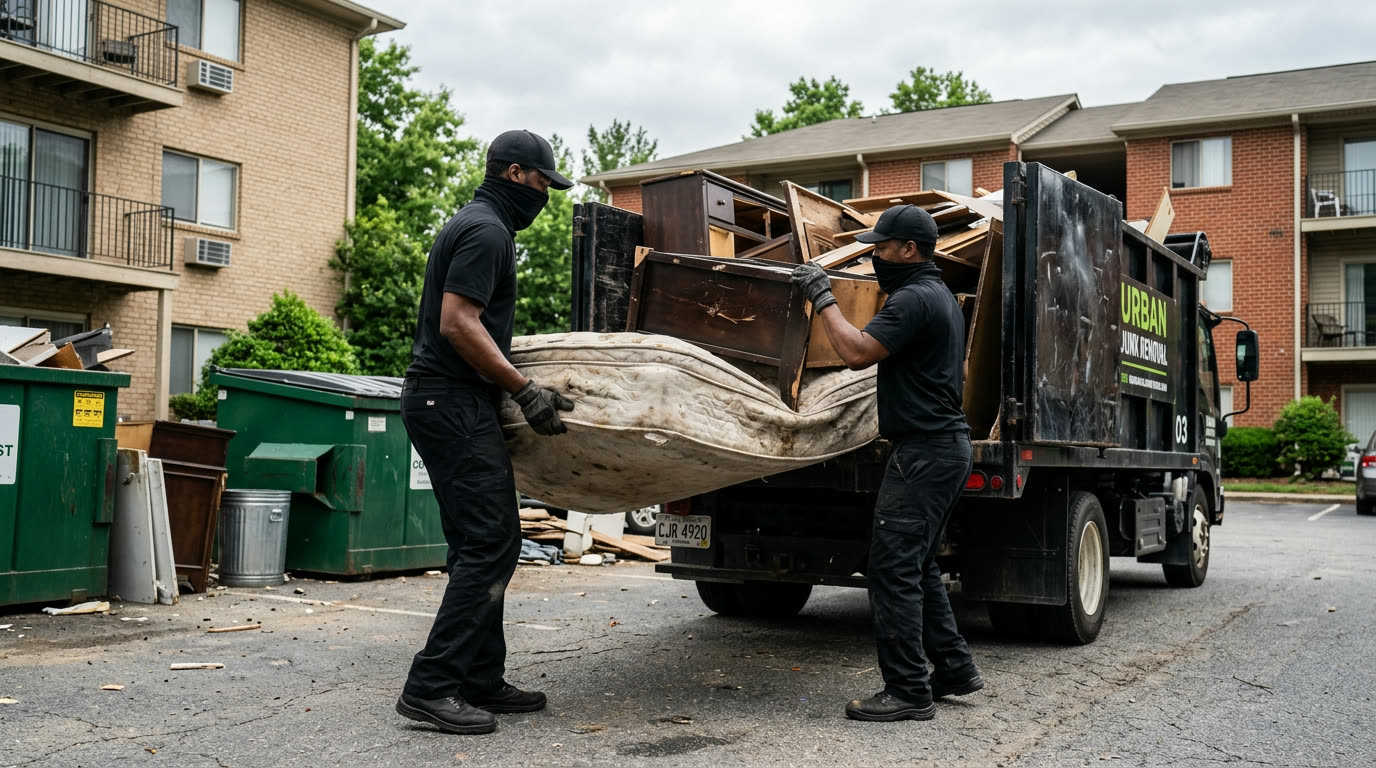
Piling up? Gone today.
From a single bulky item to a full overflow cleanup, A&M clears it fast — one-time or on a recurring route. Furniture, appliances, move-out piles, and common-area dumping, hauled and documented.
What we haul
- Furniture & mattresses
- Appliances & e-waste
- Move-out & overflow piles
- Common-area dumping
One-Time Hauls
Need it gone now? We mobilize fast, clear the load, sweep up, and send you the before-and-after. Perfect for overflow events and surprise dumping.
Recurring Pickups
Stop reacting to the same pile every week. A scheduled route keeps your dumpster areas and common spaces clear — at route pricing.
One couch by the dumpster is never one couch.
Bulk waste behaves predictably. The first abandoned item signals that leaving things there is tolerated, and within a week it has company. What started as one pickup becomes a standing feature of your property.
Accumulation compounds
A single mattress against the enclosure tells every resident — and every passing truck from off the property — that this is where things get left. Clear it in two days and it stays a one-item problem. Leave it a two weeks and you're paying for a load instead of a pickup.
Overflow costs you twice
Bulk items in or around the compactor mean contamination charges, blocked service, missed pickups and emergency hauls at emergency rates. The waste hauler's invoice goes up for a problem that isn't actually a waste-hauling problem.
It's the first thing a prospect drives past
Dumpster enclosures sit near entrances and drive lanes because that's where trucks can reach. Which means the accumulation is on the route every tour takes in, and it's shaping an opinion before anyone reaches the leasing office.
You're paying emergency rates for a problem you can predict.
Most communities handle bulk the same way: wait until it's bad enough that someone complains, then call for a one-time haul. Repeat monthly, sometimes weekly.
Every one of those calls carries the full cost of sending a truck and crew out for a single stop. You're buying mobilization over and over for volume that was entirely foreseeable — and in between, the property spends most of the month looking like the pile is winning.
A scheduled route inverts it. We're already coming, so the stop costs a fraction of a callout. The enclosure never reaches the state that generates complaints. And your spend becomes a fixed line you can budget instead of an unpredictable one you keep explaining.
See recurring programsReactive vs. scheduled
- Full mobilization every call
versus a stop on a run we're already making - Cleared after complaints
versus cleared before anyone notices - Unpredictable monthly spend
versus a fixed, budgetable line - Whatever slot is open
versus priority response when something does happen
How junk and bulk removal is priced.
Volume is the base. What moves it up or down is everything around the pile.
Volume
Priced by how much of the truck the load fills, not by item count. A dozen light items and one sectional sofa can occupy the same space and price the same way.
Disposal class
Appliances, mattresses, tires, electronics and paint carry their own fees at the transfer station and cannot ride in a general load. Itemized on the quote rather than folded into a total you can't interrogate.
Labor and access
Curbside next to the truck is one job. Third floor, no elevator, long carry to a staging point is another. Same volume, different hours.
Condition
Weather-soaked material, pest presence or contamination changes handling, protective equipment and time on site. Identified before we quote, not after we arrive.
Response speed
Same-day and after-hours pulls a crew off scheduled work and carries a premium. Frequently still the right call when a property is being toured or inspected.
Route position
The largest single lever available to you. A stop on an existing run costs a fraction of a standalone callout, because you're no longer paying for the truck to make a trip on your behalf alone.
If you're calling for one-time hauls more than about once a month, a route will almost certainly cost you less for a property that looks better the whole time. We'll tell you that on the walkthrough even though the one-off invoices are larger.
Anyone can take a load away.
They haul the pile. We keep it from coming back.
A one-time haul solves today. A route solves the pattern. We'd rather hold a property on a schedule than keep selling you the same emergency every month at a higher rate.
They take what's easy. We take what's heavy.
Appliances, mattresses, electronics and soaked or awkward material are the items that get declined at the curb or surcharged on the spot. We quote them up front and load them the same visit.
They leave it swept-ish. We photograph it clean.
Before and after on every pickup, delivered with the job. Close the work order, show ownership, and keep a record of how the enclosure actually looked when we left it.
They're one more number to call. We're already on your property.
Junk removal, pressure washing, dumpster pad cleaning, trash-outs and turns under one insured crew. Most communities that start with a bulk route end up handing us the pad and the breezeways too, because it's the same visit.
What managers ask about bulk removal.
Most one-time hauls are scheduled within 24 to 48 hours, and same-day is available when a property is being toured or inspected. Communities on a route get priority when something turns up between scheduled stops.
Yes. These carry separate disposal fees and can't be mixed into a general load, so they show as their own line on the quote. What we won't do is take the load, discover a fridge in it, and add a charge you didn't agree to.
That's the model we'd recommend for most communities. Weekly, bi-weekly or monthly depending on how fast your property generates bulk. You get route pricing, a fixed line to budget against, and an enclosure that never reaches complaint condition.
Common, and frustrating, because it isn't your residents creating it. We clear it the same way. The practical defense is speed — an enclosure that's consistently empty stops reading as a place to dump, which is the main reason routed properties see less outside dumping over time.
We sweep the area and photograph it on the way out. If the pad itself needs degreasing, sanitizing and deodorizing, that's our dumpster pad service and it can run on the same visit — which is what most communities end up doing once they see the pad without the pile in front of it.
Yes. Portfolios run under a single agreement with one point of contact and consolidated billing. Route pricing improves as properties cluster, so adding communities in the same submarket usually lowers the per-stop cost across all of them.
Junk removal across metro Atlanta
Clear it out today.
One call and the pile is our problem, not yours.