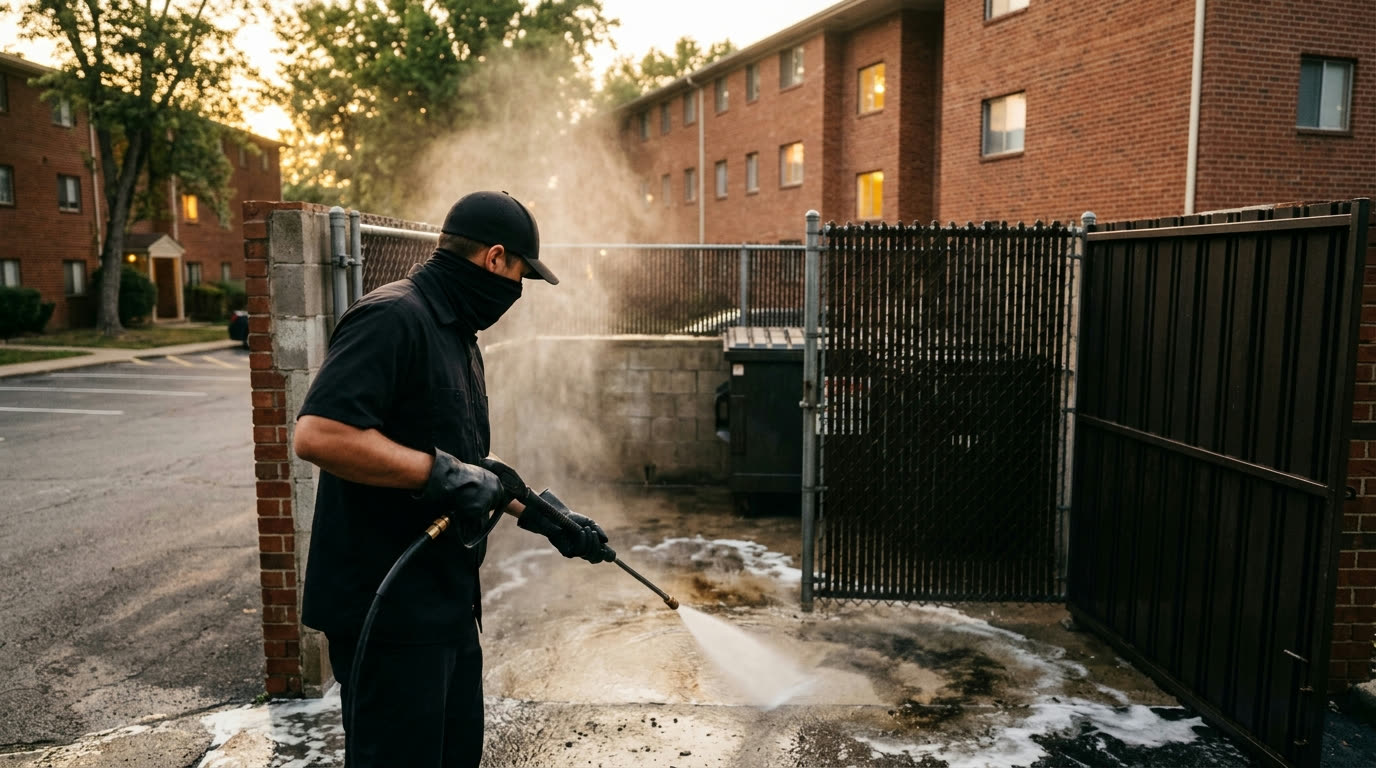
The area residents complain about most.
Grease, odor, and buildup around dumpster pads and compactors drive complaints and hurt inspections. We degrease, sanitize, and deodorize the whole area — one-time or on a recurring route so it never gets bad again.
Degrease. Sanitize. Deodorize.
Hot-water cleaning cuts the grease and grime that cold water just spreads around. We treat the pad, the enclosure, and the surrounding concrete, then deodorize so the area smells handled — not just rinsed.
- Hot-water degreasing
Lifts grease, not just surface dirt. - Sanitize & deodorize
Knocks down odor and bacteria. - Recurring route pricing
Keep it consistently clean for less.
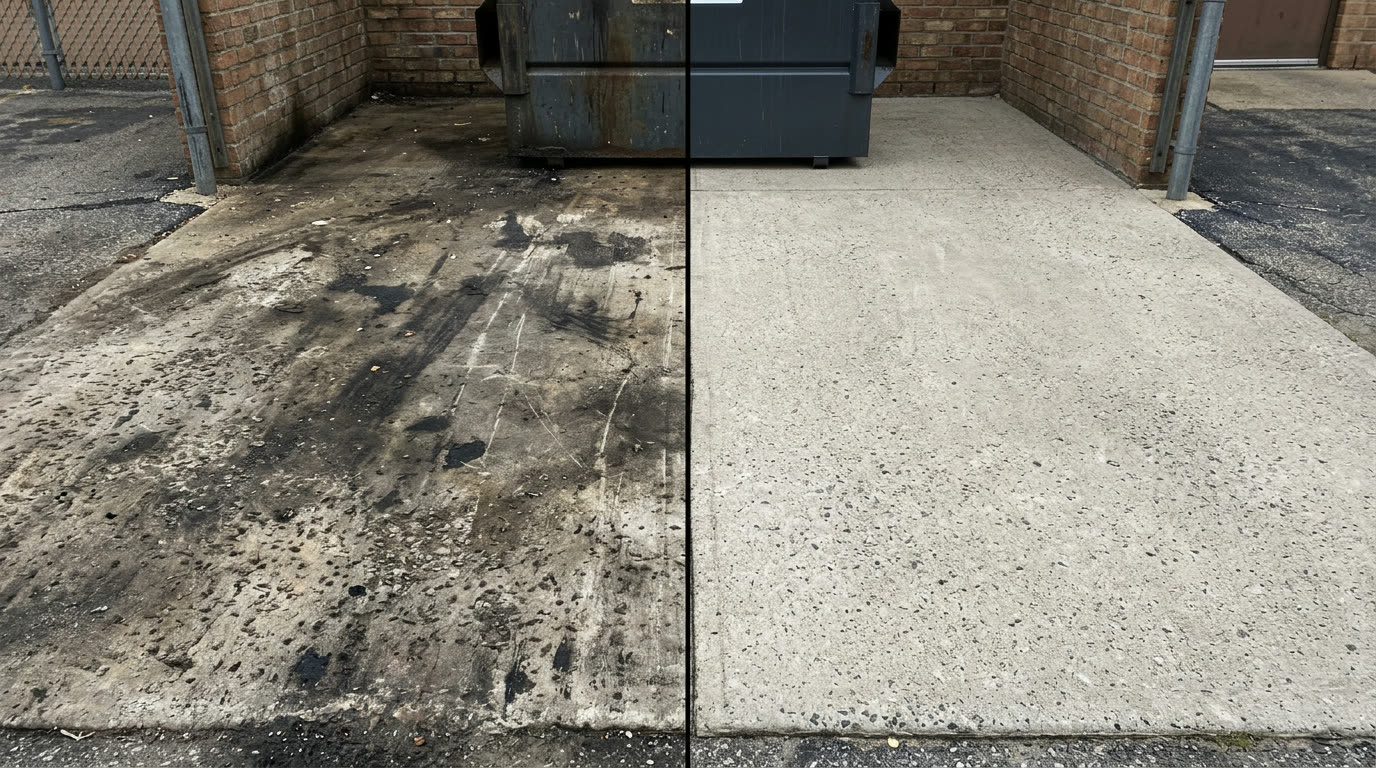 Before → After
The smallest square footage on the property. The loudest complaints.
A dumpster pad is a few hundred square feet of a property measured in acres. It also generates more resident complaints per square foot than anything else you maintain, and it's the one area a prospect can smell before they see.
Odor travels further than you think
Enclosures sit near drive lanes and building corners because that's where trucks can reach — which puts them upwind of entrances, patios and ground-floor units. Residents who never go near the pad still live with it, and in summer that becomes a maintenance ticket every week.
You're funding pest control against a food source
Rodents and roaches don't nest at the pad, they feed there and move into buildings. Spending on pest treatment while leaving organic residue baked into the concrete is paying to fight a problem you're also supplying. Removing the food source is the cheaper half of that equation.
It shows up in reviews and inspections
Prospective residents read reviews mentioning smell and pests, and health or code inspections look at exactly this area. One enclosure is capable of shaping a property's reputation out of proportion to its size.
Concrete is porous. The smell is inside the slab.
This is the part most crews get wrong. Leachate — the liquid that drains out of compacted waste — soaks into unsealed concrete and stays there. Pushing water across the surface moves the visible film and leaves everything that actually smells exactly where it was.
Degrease
Hot water and a commercial degreaser break down the fats and oils bound into the surface. Heat is not optional here — cold water emulsifies almost nothing and simply relocates the residue to the edge of the pad.
Sanitize
A separate step with a different chemistry, targeting the bacterial load living in what the degreaser released. Skipping it is why a pad can look clean and still smell by the weekend.
Deodorize
An enzyme treatment that keeps working after we leave, digesting the organic material that has already penetrated the slab rather than masking it with fragrance for a day and a half.
Three distinct steps, three different chemistries. A vendor quoting a "pad wash" is usually quoting the first one — which is why the complaint comes back and the line item gets spent twice.
How pad and compactor cleaning is priced.
Pad count and size
How many enclosures across the property and the slab area of each. Communities with several pads price better per pad than a single standalone enclosure, because the crew is already on site.
Buildup level
A pad that has never been properly treated carries years of absorbed organics and takes materially more product and dwell time than one held on a cycle.
Compactor vs open dumpster
Compactors concentrate leachate and generally need more aggressive treatment around the unit and the drain path. Open enclosures spread the problem over a wider area.
Containment requirements
Wash water from a pad carries organic load, so where it goes matters. Collection and containment are scoped into the quote rather than improvised.
Access and timing
Enclosures have to be empty enough to work. We coordinate around your hauler's pickup schedule, which sometimes means early mornings or a specific day of the week.
Frequency
The single biggest lever. Monthly or quarterly service keeps the slab from ever reloading, costs a fraction of a restorative clean per visit, and prices on route alongside your other work.
Anyone can hose down a slab.
They rinse it. We treat it.
Degrease, sanitize, deodorize — three steps with three chemistries. A rinse makes the pad look better for an afternoon; treatment is what stops the complaint from coming back next week.
They push the water somewhere. We contain it.
Pad runoff carries organic load. We manage collection and containment as part of the job instead of relocating your problem to the nearest drain and driving off.
They come when you call. We come before you notice.
Pads are ideal recurring work because the reload rate is predictable. On a schedule the area never reaches complaint condition, and you stop paying restorative pricing for maintenance-level work.
They do the pad. We're already doing the property.
Breezeways, sidewalks, bulk removal and the enclosure on the same visit, one insured crew and one invoice. The pad is rarely the only thing that needs attention where it sits.
What managers ask about pads.
That depends entirely on reload rate — how much waste the property generates and how well the enclosure is used. A restorative clean on a neglected pad buys real time, but the pad starts absorbing again the day service resumes. Properties that want the smell gone rather than paused put the pad on a monthly or quarterly cycle.
Ideally we work right after your hauler's pickup, when the container is empty and the slab is exposed. Tell us your service day and we'll schedule against it. We can work around a partially full enclosure, but the result is better with a clear pad.
We manage flow and containment as part of the scope. Pad water carries organic load, so we don't simply chase it toward the nearest storm drain. If your property has specific collection requirements, raise it at the walkthrough and we'll build it into the quote.
It removes a food source, which makes pest control work better — but it isn't pest control and we won't pretend otherwise. Communities that treat both together generally get a result neither gets alone, because spraying while the food supply stays in the concrete is fighting the same battle twice.
Yes — the unit exterior, the surrounding slab and the drain path. Compactors concentrate leachate more than open dumpsters, so the area around and beneath the unit is usually where the odor is actually coming from.
Monthly for high-volume communities and through the summer, quarterly for smaller properties or cooler months. We'll recommend a cadence at the walkthrough based on your waste volume and what the slab looks like — and we'd rather set it correctly than sell you visits you don't need.
Dumpster pad washing across metro Atlanta
Stop the complaints at the source.
Free walkthrough and a quote on your dumpster and compactor areas.